202-269-9441 info@dcfapac.org
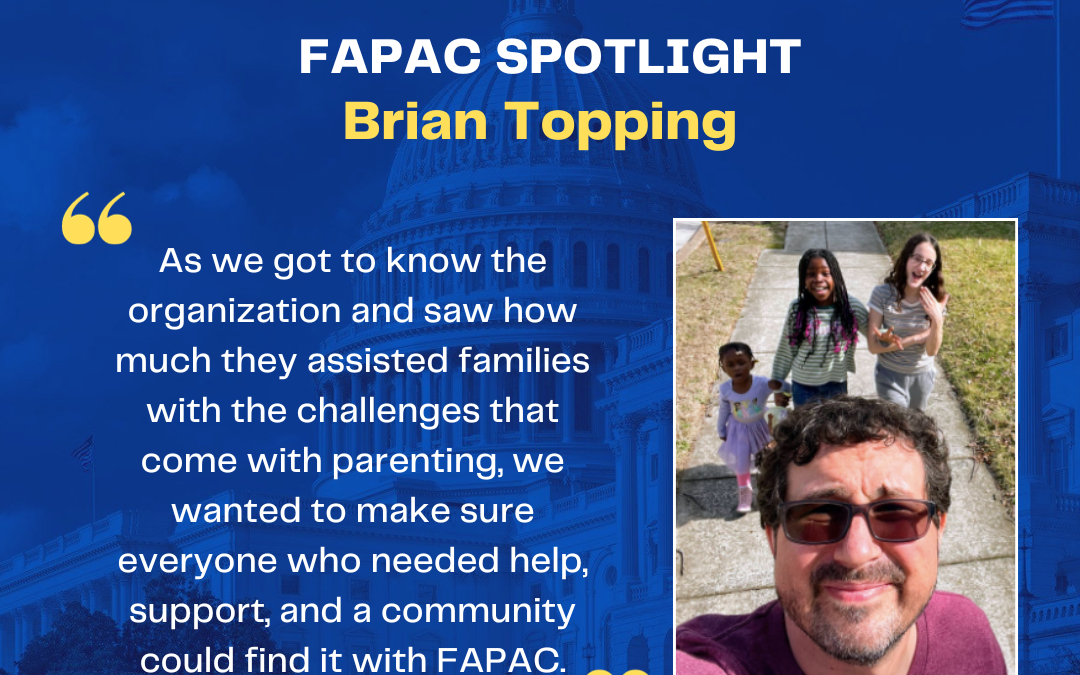
Spotlight on Brian Topping

Spotlight on Brian Topping

We asked Brian Topping, our Board Secretary, a few questions to get to know him better.

What inspired you to get involved with FAPAC?

We first found FAPAC through the trainings they offer and the peer support groups they run. As we got to know the organization and saw how much they assisted families with the challenges that come with parenting, we wanted to make sure everyone who needed help, support, and a community could find it with FAPAC. When we were placed with an infant and got to know the birth family, FAPAC helped us navigate this new shared parenting relationship– one that we maintain more than five years after the child’s reunification with the birth family. FAPAC was there for us and also gave us the opportunity to contribute to the development of new resources that support shared parenting for more families and across the Child and Family Services Agency.  

What do some of your responsibilities look like as a board member?

I have been the secretary for several years, so I take notes at board meetings and keep track of the timing of board elections. I also try to provide a voice of resource and adoptive parent experience. 

What other work are you involved in outside of FAPAC?

I work for the US Environmental Protection Agency to authorize development while protecting and restoring streams and wetlands. We have three daughters and two dogs that also keep my wife, Kate, and I very busy.

What has been one of your favorite memories/experiences with FAPAC?

The annual holiday party is a wonderful event and opportunity for foster kids to just have fun, get presents, and celebrate with their birth and foster families together. I have many fond memories of attending with foster children and their birth families, volunteering at it, and coming together as an organization to make it happen and clean up afterwards.

 

Spotlight on Najiba Hlemi

Spotlight on Najiba Hlemi

We asked Najiba Hlemi, FAPAC’s Executive Director, a few questions to get to know her better.

What does a typical work week look like for you?

Where do I begin? On any typical week, I am figure out ways to better serve children and families, editing grant applications, submitting reports to funders, meeting with stakeholders or our team, strategizing on our various goals, moving boxes, ordering supplies, answering phone calls and emails, looking for new funders, catching up on recent studies and trends in the foster care world, and so much more. No two days are the same for me, and I love every minute of it!

How did your journey at FAPAC begin? What drew you to this organization?

It feels serendipitous that I get to work with youth and families in foster care, being that I also came out of foster care. If you told me years ago that I would have the opportunity to lead a foster care organization, I would not have believed you. This work we accomplish with an incredible team of amazing people feels like a dream because I get to do what I love daily for a cause that is dear to me. My background is in marketing and nonprofit management and working with various nonprofit organizations. FAPAC became my home because of its mission and the opportunity to work directly with families involved in foster care.

What was your background prior to joining FAPAC?

Prior to FAPAC I was the Executive Director for an after-school program for underserved youth, and before that for an association where I really got to sharpen my legislative advocacy skills. Before that I worked for a teacher’s union, and then prior to that I was in sales. I have a master’s degree in nonprofit management, an MBA, a bachelor’s in business marketing, and another in French. I love being able to market and grow nonprofit organizations.

How has FAPAC changed over time? What is something you’d like to see in the future?

FAPAC has had a strong history in advocacy for foster parents, and my predecessor and our co-founder was an incredible advocate with exceptional knowledge. Thanks to her leadership at FAPAC, critical policies were developed and implemented in the DC child welfare system. Looking forward, we seek to bring more voices to the table to expand our services to foster, adoptive, and kinship parents and youth with lived experiences. In the future, I would like to see youth and parents come together more frequently to problem-solve to better the “system”.

What has been your favorite part about working at FAPAC? What makes your role and this organization so special to you?

My favorite part is our team! When we’re together, we do amazing things, but we also laugh a lot and enjoy being with each other. My role at FAPAC is to be a servant leader. Whatever my team needs, I will step in, as we all are willing to do. This is our work of heart!

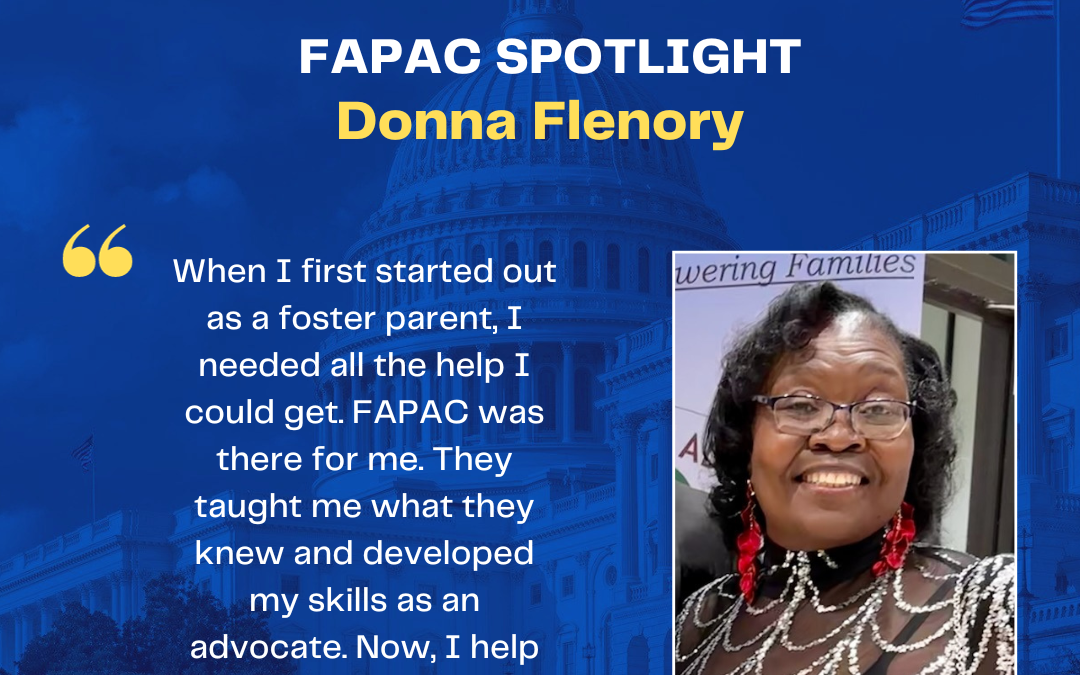
Spotlight on Donna Flenory

Spotlight on Donna Flenory

We asked Donna Flenory a few questions to get to know her better.

What inspired you to get involved with the foster care community?

I was invited to participate in a pilot program for highly-at-risk youth in foster care. The program was supposed to last six months and turned into ongoing fostering. The guidelines were one youth, one home and you could not work outside of the home– which was perfect for me. Fostering has taken me places I never thought I would go.

How long have you been involved with FAPAC?

I became involved with FAPAC in 2000– the year I began fostering and the year they gained their autonomy as an organization. I was somewhat of a groupie and hung out at the office a lot, so they put me to work. I would do whatever was helpful and was asked to join the board in 2007.

What do some of your responsibilities look like?

I roll up my sleeve and work wherever needed by FAPAC. My previous responsibilities included but were not limited to conducting the board meetings and communicating and partnering with sister agencies in the city. I represent FAPAC at the Mayor’s Advisory Committee on Child Abuse and Neglect (MACCAN), as well as on other councils like the Department of Behavioral Health (DBH) and the Children’s Round Table. 

What other work are you involved in outside of FAPAC?

I foster a male teenager, which fills a lot of time!

What makes FAPAC special to you?

The foster parents in DC need an advocate to hear their concerns and aggregate those that are showing a pattern. These issues are systemic in nature, so we present them to CFSA (Child and Family Services). When I first started out as a foster parent, I needed all the help I could get. FAPAC was there for me. They taught me what they knew and developed my skills as an advocate. Now, I help other parents.

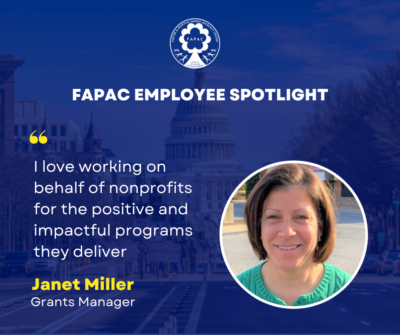
Spotlight on Janet Miller

Spotlight on Janet Miller

We asked Janet Miller, our grants manager, a few questions to get to know her better.

What does a typical week at FAPAC look like for you?
As the Grants Manager, most of my time is spent writing grant applications, reporting our progress to grant providers, researching new opportunities, checking different databases, looking at 990 forms, and updating the database so that FAPAC can send its year-end reports. I then document FAPAC’s programs and our accomplishments so that I can better inform our audience.

What did you do before FAPAC? 
Before FAPAC, I worked for and collaborated with small to large nonprofits and for-profit organizations in Annapolis. I handled marketing and administration until finding my niche in grants management. I love working on behalf of nonprofits for the positive and impactful programs they deliver, from after-school programs, mental health, homelessness, food and pantry, and group/family homes. I enjoy looking for different topics, setting goals and objectives, and meeting them.

What is your favorite part of working at FAPAC or in nonprofits?
My favorite parts of FAPAC are the team and how well we hold up and get things done. We are given much independence, allowing me to do my work freely. FAPAC’s big thing is identifying and structuring the program around that need. Once programs are implemented, we assess our progress and potential improvements, and if they are not successful, we find better programs.

Your position is mainly done remotely. What motivates you, and how do you stay on top of your work? 
To stay motivated, I focus on lists and targets on what I need to do daily. This helps me prioritize things. The staff meetings are great because it helps me get back on track while giving me updates on what projects my colleagues are working on. It makes you feel more connected, especially when communication is always significant for me.

Thank you Janet for your amazing work at FAPAC!